
Driving in the UK: 31 Essential Tips for American Tourists
You’ve made it through the airport, picked up your rental car, and pulled out onto the road. Everything seems good, until the sat nav takes you directly to a roundabout with three lanes and signs that you’ve never seen before.
Driving in the UK isn’t hard, but it is different — especially if you’re used to American roads. From unfamiliar signs and narrower lanes to speed limits that change without warning, it can feel like the rules are written in a slightly different language.
I’m British, and I learned to drive in the thick of London traffic — but I’ve also road-tripped across all 48 continental US states. So I’ve experienced both systems and understand where the confusion often kicks in.
This guide shares 31 practical, on-the-ground tips for driving in the UK — especially useful if you’re more familiar with North American roads. Whether you’re cruising the Cotswolds or navigating a motorway, these tips will help you stay confident, informed, and (hopefully) a bit less stressed behind the wheel.
Looking for more UK travel content? You’ll find it all in my UK Travel Guide.


📘 Just a Heads-Up
These tips are based on my own experience driving in the UK (and abroad), and they’re here to help you feel more prepared. But for the full legal rules, it’s always best to check the UK Highway Code — that’s the official guide to everything you need to know.
All drivers must present a full valid driving licence. If the driving licence is written in a language that is not English, an International Driving Permit is also required. Rental companies may also have age restrictions for you to hire a car.
Before You Start The Car – Renting, Fuel, and Car Basics
1. Manual vs Automatic Cars
Most cars in the UK are still manual, although this is changing as hybrids and electric cars become more common. Unless you are used to driving a manual/stick shift, I recommend hiring an automatic car even if it is more expensive.
I drive a manual in the UK and I would still choose an automatic in other countries – you have enough to think about already without having to shift gear with the wrong hand.
⚠️ Be careful when booking: if you don’t specifically check the one you choose is an automatic, you’ll almost certainly be given a manual by default.
2. Fuel Types in the UK: Petrol vs Diesel
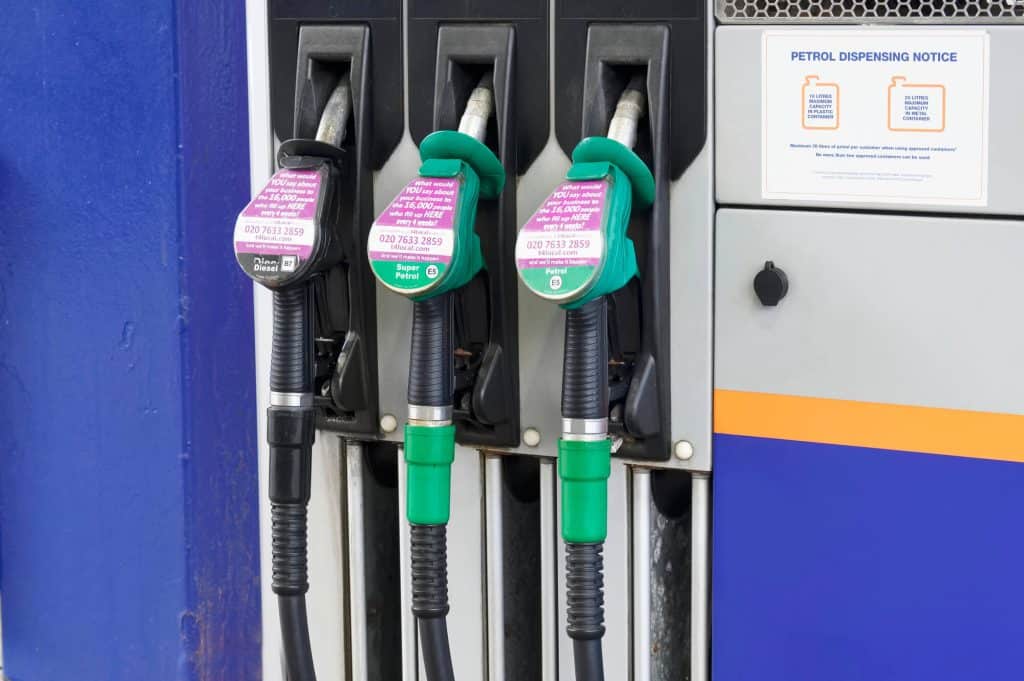
Cars will either be petrol (what Americans call gas) or diesel. Make sure you know which type of fuel your hire car uses as filling up with the wrong type can be a very expensive mistake. You’ll probably hire a petrol car, but check to be certain.
PRO TIP: At petrol stations, the pumps in the UK are the opposite colours to the US. Make sure you read the fuel type on the pump and don’t just look at the colours.
3. How Much Does Fuel Cost in the UK?
Fuel is significantly more expensive in the UK than in most parts of the US — sometimes double, depending on where you’re from. When I was road-tripping in the States, I couldn’t believe how cheap it was, but I also noticed how much prices varied between states, depending on taxes.
In the UK, prices are more consistent across the country — but generally much higher overall. A full tank for a small car might cost £60-80, and that’s perfectly normal.
We also make it unnecessarily confusing: fuel is sold by the litre (not the gallon), but fuel economy is still measured in miles per gallon. Exchange rates, unfamiliar units — it’s a headache. Just assume it’s going to cost more and try not to do the maths.
4. Car Rental Insurance: What You Need to Know
A minimum of third-party insurance is a legal requirement in the UK. Always check what type of cover is included in your rental — and whether it’s enough for your needs. Basic policies may leave you with a hefty excess (deductible) in the event of damage.
Your credit card or travel insurance might offer additional coverage, but you’ll need to check the fine print to confirm what’s included and whether it applies outside your home country.
Insurance rules in the UK are strict. Uninsured cars can be towed without warning, and the driver can face fines or points on their licence. UK police routinely check for insurance compliance using automatic plate recognition systems.
One thing many visitors don’t realise: you’re not just insuring the car — you’re insuring specific people to drive it. If someone not named on the policy gets behind the wheel, the insurance is likely invalid. If more than one person plans to drive the rental, make sure they’re all officially added when you book it.
I’ve only had to use my UK insurance once — someone reversed into the side of my parked car while I was at home with the flu. I didn’t even notice for three days. Thankfully, it was a responsible driver who left a note with their details, and the claim was handled quickly. It made me appreciate how seriously insurance is taken here — and how important it is to have proper coverage.

5. Why Smaller Cars Make Driving in the UK Easier
Roads in the UK — especially outside major cities — are much narrower than what you’re likely used to in the US. Smaller cars are easier to handle on country lanes, simpler to park, better on fuel, and cheaper to hire.
I’ve driven all over the UK in my little Citroën C3 — from motorways to winding roads in the Scottish Highlands and narrow village lanes in the Peak District. It’s not a powerful car, and yes, I’ve had to crawl up a few steep hills in first gear, but it’s never let me down.
When I’ve driven in the US, I’ve gone for bigger SUVs to cope with long highway stretches, steep climbs in national parks, and wider roads. But in the UK, a small car is far less stressful — and far more practical.
⚠️ Don’t go big just because you’re used to it. In the UK, a massive vehicle will just make everything harder: tighter turns, smaller parking bays, narrower roads. Go for something compact, with decent power, and you’ll thank yourself later.

6. What To Do in a Driving Emergency in the UK
In the UK, the main emergency number is 999. This connects you to a call centre where you’ll be directed to police, ambulance, or fire and rescue services as needed.
In order to keep 999 available for real emergencies, you should also know about:
- 101 — For non-urgent police matters (e.g. reporting a minor accident or suspicious activity)
- 111 — For non-emergency medical advice (e.g. if you’re ill but not in danger)
If you break down on a motorway, try to safely move your car into a lay-by or the left-hand verge. Then, exit the vehicle on the left (passenger) side and get behind a barrier if there is one.
Many UK motorways are now smart motorways, which means the hard shoulder may be open to traffic. If the overhead signs don’t show a red X above the lane, it could be live. Standing near your vehicle in a live lane is dangerous.
Always try to create a physical barrier between you and moving traffic. If you’re stuck in a live lane or a position that feels unsafe, call 999 immediately.
7. How UK Petrol Stations Work (and What Surprises American Visitors)
Most UK petrol stations (which also sell diesel) operate on a fill-first, pay-after system. You’ll fill up your car, then go inside to pay at the counter. The pump will have a number — just tell the cashier, and they’ll charge you the correct amount.
Some stations offer a pay-at-pump option, where you insert your card and enter your PIN before fuelling. Once you return the nozzle, the machine deducts the amount automatically.
This setup often surprises US visitors, who are used to prepaying and wonder why people don’t just drive off without paying. In reality, each pump is covered by CCTV linked to licence plates, and stations can easily report unpaid fuel. It’s not worth the risk.
Also, UK pumps don’t have that handy locking latch you might be used to — you’ll need to hold the handle the whole time you’re fuelling.
🚗 Road trip tip: In rural areas, petrol stations can be few and far between. Keep your tank at least half full if you’re heading into the countryside.
🛣️ On motorways and major A-roads, you’ll see signs for Services — these usually include fuel, toilets, food outlets, and parking. They’re convenient but often more expensive than filling up at normal petrol stations.
And while they do the job, I’ll admit I miss Buc-ee’s and Love’s from my US road trip — especially the cheap coffee and Buc-ee’s peanut brittle. There’s nothing quite like that in the UK.

8. How Parking Works in the UK (and How to Avoid Fines)
Car parks in the UK use a few different systems, and it’s important to check how it works before you leave your car:
- ANPR (Automatic Number Plate Recognition): Cameras record your number plate when you enter. Before you leave, you enter your registration at a machine, and it calculates your fee based on how long you stayed.
- Pay & Display: You estimate your parking time, pay upfront at a machine, and display the printed ticket on your dashboard. Overstay, and you’re likely to be fined.
- Parking Apps: Many car parks now allow payment through apps link RingGo or PayByPhone — you’ll often see the option listed on the side of the machine. Most accept either card, contactless, or app, but a few older machines still only take coins.
Enforcement is handled by both traffic wardens and camera systems — and they are active. I’m a bit paranoid and often take a photo of the machine after paying, just in case there’s ever a dispute.
Street parking has its own rules. You can’t park on double yellow lines at any time. Single yellow lines allow parking only at certain times, which are posted on signs nearby. These rules can change from one end of the street to the other, so always double-check.
Park and Ride is a great alternative when visiting older UK cities like Oxford and Cambridge — places that were built long before cars existed. These systems let you park on the outskirts and take a regular bus into the city centre. It’s cheaper, less stressful, and often much quicker than trying to find a central spot.
🔹 Bonus Tip: Reserve Private Parking with JustPark
If you’re heading to a busy event or into a city where parking is tight, JustPark is a handy app that lets you book private driveways and spaces in advance, almost like reserving a hotel room for your car.
It’s especially useful when you know regular car parks or street spots will be full. Listings often include photos and dimensions of the space, so you can check whether it will suit your car before booking.
I’ve used it before for events and it saved me a lot of stress — knowing I had a guaranteed spot waiting made everything simpler.

UK Driving Rules for First-Time Visitors
9. Drive On The Left
This is the most obvious difference, but it can still catch you out. In the UK, we drive on the left-hand side of the road, and the steering wheel is on the right-hand side of the car. You’ll probably adjust to this faster than you think, especially if you’re using a rental car designed for UK roads.
That said, it’s the small moments, like turning into side streets, driveways, or car parks, where mistakes creep in.
When I was road-tripping in the US, I adjusted to driving on the right surprisingly fast. But on one of my first days, I accidentally turned into the exit of a parking lot instead of the entrance — and couldn’t understand why the barrier wouldn’t lift.
It took me far too long to realise I was on the wrong side of the road (to be fair, that parking lot didn’t have any obvious entrance or exit signs). I backed out and found another lot, but I’m pretty sure everyone walking past thought I was drunk or clueless.
If you’re nervous, a sticky note on the dashboard — “STAY LEFT” — can help in the first few days. And if you have a passenger, ask them to double-check your position after turns or when exiting junctions. It’s not about confidence — it’s about habit.
10. Seatbelts
In the UK, wearing a seatbelt is a legal requirement for both the driver and every passenger, in the front and the back.
Honestly, I barely think about it. It’s just automatic — as normal as closing the door behind you. If you’re in a car, your seatbelt should be on.
Police can (and do) stop drivers or issue fines if someone isn’t belted up. Most cars will also have persistent alarms until everyone clicks in, so it’s not something you can easily ignore.
11. Using Phones While Driving: UK Laws and Penalties
Using a handheld mobile phone while driving in the UK is illegal — even if you’re stopped in traffic or at a red light. You must be fully parked (engine off, in a safe place) before touching your phone or SatNav.
This isn’t taken lightly. If you’re caught, you’ll face a fine and 6 penalty points on your licence — that’s halfway to disqualification in the UK, where 12 points usually means losing your right to drive.
Even as a visitor, the DVLA (Driver and Vehicle Licensing Agency) can create a driving record for you and apply those points. If you collect more points in future visits, you could be banned from driving in the UK altogether.
The only legal exception is if you’re calling emergency services (999 or 112) and cannot safely pull over first.
You can use hands-free devices, but you must set your directions or make your call before you start driving.
📸 You’ll see a few photos throughout this post that were taken inside my car — just to clarify, my car has an inbuilt camera system, and I wasn’t holding a phone while driving!
12. Alcohol Limits
It should go without saying that drinking under the influence of alcohol or drugs is a terrible idea, and if you intend to drive you shouldn’t drink any alcohol.
In the UK the police don’t generally do field sobriety tests – they go straight to a breathalyser and you are likely to lose the ability to drive in the UK if you fail. You are not allowed to refuse to submit to a breath test – you will be arrested if you try.
The limits in the UK are measured by micrograms per 100 millilitres of breath, and the limit is 35 in England, Wales and Northern Ireland, and 22 in Scotland.

13. Road Signs
UK road signs follow a different system than what many US visitors are used to. Instead of written instructions, we rely heavily on symbols and colour coding — and it can feel like learning a new language at first.
The most important difference? In the UK:
- Red circles mean prohibitions (e.g. no entry, no turning)
- Triangles are warnings (e.g. sharp bends, junctions ahead)
- Blue circles often indicate mandatory actions (e.g. keep left)
Priority signs and junction warnings are especially important if you’re driving on unfamiliar rural roads — they let you know when to stop, give way, or expect traffic from unexpected directions.
You’ll pick things up quickly as you go, but it’s worth reviewing the most common signs before you drive — especially if you’re used to more text-based signs.
The Highway Code website lists the road signs you should be aware of. Some are obvious – others less so.

14. Give Way Signs
Stop signs are rare in the UK. Instead, we have Give Way signs and road markings. These allow the primary road to keep flowing while cars leaving smaller roads must wait for a gap.
Sometimes there are road signs, other times the requirement to give way is only marked by painted lines on the road.

15. Box Junctions
You’ll see box junctions marked by a yellow criss-cross grid on the road — usually at busy intersections. The rule is simple: you must not enter the box unless your exit is clear.
That means you can’t stop any part of your car in the box, even briefly, unless you’re waiting to turn right and oncoming traffic is preventing your turn.
Box junctions are designed to prevent gridlock — but they’re easy to misjudge if you’re used to different traffic norms or if other drivers force the situation.
I’ve accidentally ended up in a box junction before. Someone used the wrong lane and then pushed in front of me into the space I was aiming for. It left me partially stuck in the box. Luckily that junction didn’t have a camera, but many do, and I know several people who’ve been fined for being just a few centimetres over the line.
Enforcement is strict, especially in cities like London. The fine can feel harsh if you’re unfamiliar with the rule — but unfortunately unless you can prove that it definitely wasn’t your fault, there isn’t much leeway.
16. Red Light Cameras
These aren’t generally as easy to spot as speed cameras, but some red lights do have cameras to catch anyone going through when they shouldn’t. Remember that unlike the USA, turning on a red light is not allowed anywhere.
Also, you may find that the amber phase of traffic lights is shorter in the UK than in the USA. In the UK it is generally 3 seconds but can be up to 6 seconds in the USA – if it is safe to stop, don’t take the risk that you’ll be able to get through on amber before it turns red.
17. Overtaking
Overtaking in the UK is tightly regulated — and it’s not just about knowing when to pass, but where and how.
Centre Line Markings:
- If your side of the road has a dashed line, you may overtake if it’s safe.
- If your side has a solid white line, you cannot overtake, even if the other lane looks clear.
- If both sides have solid white lines, overtaking is prohibited in both directions.
💬 I’ve included a couple of photos below taken from my car, showing the difference between when overtaking is allowed and when it isn’t. These road markings aren’t intuitive if you’re used to US roads, and I know they trip up plenty of visitors.

Lane Usage:
- Always drive in the left-most lane, unless you’re overtaking or need to change lanes for a turn.
- Middle and right-hand lanes on dual carriageways and motorways are for overtaking only. Sitting in these lanes when you’re not passing anyone is considered poor driving — and in some cases, police may pull you over for it.
Undertaking (passing on the left) is not technically illegal, but it’s strongly discouraged. If done carelessly, it can be classed as dangerous or inconsiderate driving, especially on motorways.
⚠️ If in doubt: stay left, check your mirrors, and don’t rush overtaking. It’s better to wait than to misread the markings or lane etiquette.
18. Road Exits
Unlike the USA, road exit numbers are completely unrelated to the distance travelled from the road’s origin. After passing Exit 1, whether the next exit is 1 mile away or 20 miles away, it will be Exit 2.
19. Navigation
UK postcodes refer to a very small area. On average a postcode covers just 15 properties. This makes postcodes the most accurate and efficient way to input an address into your chosen device.
If you are visiting a rural attraction such as a stately home, check their website as they sometimes specify a different postcode to get you to the main entrance.

20. Speed Limits
Speed limits in the UK are posted in miles per hour (mph), not kilometres — which can catch out visitors from countries that use km/h.
Before I get into the details, the most important thing is to make sure you are paying attention to road signs. SatNavs may not get it right. Signs and road markings are what you need to pay attention to.
Motorways and Dual Carriageways
- The standard speed limit is 70mph.
- It won’t be higher than this, but can be lower — especially near junctions, roadworks or congestion.
- Always check signs — speed cameras are often linked to temporary changes, and your SatNav might not catch them.
If you see this sign below, it means the national speed limit for that type of road applies. For example, you might see signs on a motorway saying 50mph, and then this white circle with a diagonal black line. It means the limit has gone back up to 70mph.

Look out for them – local drivers will immediately start to accelerate to the national limit for that road.
Single Carriageways
- The national speed limit is 60mph, unless otherwise posted.
- But here’s the reality: many rural roads are narrow, winding, and blind. 60mph might be legal, but it’s rarely a good idea.
I’ve driven plenty of single-carriageway roads where 45–50mph felt fast enough. If a tractor, cyclist, horse rider — or even a hidden junction — is around the corner, you need time to react.
Locals often drive these roads at full speed because they know every bend. That can feel intimidating, but I’d rather hold someone up briefly than risk a crash. Sometimes I pull over to let them pass if there is somewhere safe to do that. Other times, I just stick to a speed I know I can handle and just try not to feel guilty.

⚠️ Just like with the national speed limit sign for motorways, you’ll also see it occasionally on single carriageway roads, particularly if you are entering and exiting small villages which may have a short 30mph limit, followed by the national speed limit sign bringing you back up to 60mph limit for single carriageways.
Restricted Roads (Built-Up Areas)
A restricted road is one in which there is “a system of street lighting furnished by means of lamps placed not more than 200 yards apart”. This essentially means roads in residential and commercial areas with street lamps. It’s the legal term for residential roads, but we don’t actually call them restricted roads on a daily basis.
- The default limit is 30mph.
- You’ll often see 20mph zones — especially near schools, residential areas, or high-footfall streets. These will always be clearly signed and marked.
⚠️ Some areas across the UK — including parts of England, Scotland, and Northern Ireland — are introducing more 20mph zones at the local council level. These aren’t national changes like in Wales (see below), but they are becoming more common and are backed by road safety data.

Local Roads In Wales
Since 2023, the default speed on local roads in Wales has been lowered from 30mph to 20mph.
This caused controversy and is under partial review, but most urban and residential areas in Wales still operate at 20mph unless signed otherwise.
Don’t trust your SatNav — it may be out of date. If in doubt, stick to 20mph in built-up Welsh areas.
21. Speed Cameras in the UK: What to Watch Out For
Speed enforcement in the UK is very different from what many US visitors are used to.
You won’t often see police with radar guns or cruisers hiding at junctions. Instead, the vast majority of speeding tickets are issued via fixed speed cameras, which are common across motorways, dual carriageways, and even rural roads.

📸 What to Look For:
- Fixed speed cameras are usually bright yellow and mounted on roadside poles.
- They’re often visible — but not always. Some are partially hidden by trees or signs, and if you spot them too late, slamming the brakes can be dangerous.
- The best approach? Stay at or under the speed limit at all times, especially on unfamiliar roads.
This system is quite different from what I saw in the US. Over there, I found it intimidating to drive near big cities where people flew past me doing 10mph over the limit in heavy traffic. In the UK, people seemed to generally stick to the limit more because they know fixed cameras are watching.
I’ve also seen police cars sitting just past state lines in the US, waiting to catch people who don’t notice a speed limit change after crossing. You won’t see much of that here — but the camera network is unforgiving if you’re not paying attention.
📏 Average Speed Cameras:
- Some roads use average speed checks instead of spot cameras. These measure your speed between two points using time and distance.
- You’ll see clearly marked signs for average speed zones, and the cameras themselves are often mounted on much taller poles than standard speed cameras.
- Braking for a single camera won’t help — your speed is calculated over the entire stretch.
22. Toll Roads
There are a few toll roads around the UK. Most, but not all, of them are bridges and tunnels. The charges vary as do the payment methods. For some of them you pay using cash or card at a toll booth. Others work by registering your number plate.
If you cross a toll road without paying at a booth, make a note of where it was and pay online when you complete your journey.
You usually have 24 hours to pay the toll so you don’t need to panic about doing it immediately, but try to do it the next time you stop so you don’t forget.
Roads, Roundabouts & Real-World Driving
23. UK Roundabouts: A Guide for American Drivers
Roundabouts are everywhere in the UK — from tiny single-lane junctions to massive four-lane spirals that look like something out of a maze.
It’s not unusual for me to use more roundabouts in a single day here than I did in six months driving around the US.
Because they vary so widely, and the rules around lane discipline and signalling can feel unfamiliar, I’ve embedded a YouTube video below that gives the best visual guide I’ve seen.
📺 Watch it before you drive if you’re not already comfortable with roundabouts — it’ll make your first few much less stressful.
When I was learning to drive, I actually asked my instructor to take me on extra lessons specifically focused on roundabouts so I could get used to them.
One of the few mistakes I made on my driving test was stalling at a roundabout. I genuinely thought I might fail — but because I restarted the car safely and calmly, it was just marked as a minor error and I passed. That experience stuck with me — roundabouts can be intimidating, but you can get through them with a bit of practice and patience.
24. UK Road Types Explained: Motorways, A Roads, B Roads & More
UK roads are classified with letters and numbers (like M1 or A406) — but what matters more is how the road is built and how it behaves. Here’s what to expect:
M Roads
These motorways (M1, M4, M25 etc) are equivalent to the US interstates and freeways. There are the biggest roads in the UK with the most lanes and the highest speed limits.
They’re multi-lane, well-maintained, and limited to motorised traffic only — no cyclists or farm vehicles allowed.

A Roads
A roads are major routes that can vary between:
- Dual carriageways (separated lanes, higher speeds)
- Single carriageways (slower, with more junctions and traffic lights)
They often link cities and towns and can feel a bit more intense than motorways due to junctions, roundabouts, and mixed-use traffic. The hardest bit about a motorway is joining and leaving it – A roads have more going on.

B Roads
B roads are secondary routes, often used for local or scenic journeys rather than direct intercity travel.
They can range from full dual carriageways to narrow, winding roads that look like country lanes — so the letter “B” doesn’t always tell you much about the width or speed.

Dual Carriageways and Single Carriageways
This catches many visitors out. It’s not about number of lanes, but whether there’s a physical divider between opposing directions:
- Dual carriageways: Separated by a barrier, curb, or median.
- Single carriageways: Opposing traffic is only separated by painted lines.
⚠️ Speed limits differ depending on this.
Single Track Roads
Common in rural areas, these roads are only wide enough for one vehicle at a time — but traffic flows in both directions.
You’ll see regular passing places marked by signs or wider verges. Look ahead, yield early, and don’t assume others will stop.
One of the steepest single-track roads I’ve driven was the road to Applecross in Scotland (Bealach na Bà) — narrow, winding, and dramatic. On the way back down, I spotted an old car with a Swedish flag hanging out the window, crawling slowly uphill with no passing place between us.
I held back at a corner, and the driver reversed slightly to a flat bit of road. Then they gave it everything — full throttle, clouds of smoke, and a bit of a wobble — to power up the slope. They were clearly relieved I’d waited, and I was happy to let them take the easier path. These roads are as much about courtesy as they are about skill.

25. Jaywalking and Pedestrian Prioritisation
In the United Kingdom it’s not illegal for pedestrians to cross roads at places that aren’t designated crossings. This does mean that sometimes a pedestrian will cross the road where you aren’t expecting it, so keep an eye out for pedestrians who look like they are about to step into the road.
What Drivers Need to Know:
- If a pedestrian is already crossing the road, you must yield to them.
- At zebra crossings, pedestrians have absolute right of way — and UK drivers are trained to stop as soon as someone approaches the kerb.
- Be alert near schools, parks, or pubs — people may step out unpredictably, especially in the evening.
Even outside of formal crossings, UK driving culture tends to lean more pedestrian-friendly than in many parts of the US. Give way when in doubt, and avoid honking unless absolutely necessary.
26. Pedestrian Crossings
The UK has five types of pedestrian crossings: zebra, pelican, puffin, toucan, and pegasus. It sounds complicated — but for drivers, they fall into two simple categories:
🚦 1. Traffic Light-Controlled Crossings
These include pelican, puffin, toucan, and pegasus crossings. They all work in essentially the same way from your perspective:
- A red light means stop for pedestrians.
- Once the light turns green, you can continue as normal.
🟡 Pelican crossings sometimes show a flashing amber phase before turning green. You may drive through the crossing only if all pedestrians have finished crossing and the path is clear.
🔍 (For reference: toucan = pedestrians + cyclists, pegasus = horses — but unless you’re riding a horse or towing one, it doesn’t matter.)

🦓 2. Zebra Crossings
Zebra crossings are marked by zig-zag white lines on the road leading to a path of bold black-and-white stripes across the street. You’ll also see flashing amber beacons on poles.
These are not controlled by traffic lights, but you are legally required to stop if a pedestrian is waiting to cross.
⚠️ Failing to stop at a zebra crossing can result in a fine, penalty points, and even prosecution if an incident occurs.
Pedestrians in the UK are used to cars stopping for them at zebra crossings, and many will start walking without hesitation once they see you slowing down. Stay alert — and stop fully when required.
27. Cyclists
Cyclists are common in towns and cities. Watch out for them and ensure you leave enough space when going around them.
Also, check behind you when opening your car door to make sure there aren’t any cyclists about to pass the car when you are getting out of it.
A few key rules:
- Give cyclists at least 1.5 metres (about 5 feet) when overtaking — and more if you’re going faster or on a windy road.
- At traffic lights — some junctions have bike boxes (advanced stop lines) where cyclists can wait ahead of vehicles.
- On narrow lanes or in city traffic — they may move unpredictably, so anticipate slower movement and wider turns.
Cyclists are meant to follow road rules in terms of traffic lights etc, but not all of them do especially in city traffic.
⚠️ Cyclists are considered vulnerable road users in the UK. Any incident involving one will usually be investigated thoroughly — and the burden of responsibility often lies more heavily on the driver.
28. Speed Bumps
It’s common for residential roads to have speed bumps to keep cars at a lower speed. It’s important to slow down for these – going over them too fast can cause damage to your car, and it’s not always obvious how harsh the bump is.
There is a set near me that you can only go over at about 8mph to avoid getting a big jolt, but most of them are fine at or slightly below the posted speed limit.

29. Bus/Taxi Lanes
Many cities have lanes dedicated to taxis, buses and bicycles. These make public transport more efficient but can catch drivers out as some have cameras to catch and fine cars in bus lanes.
Bus lanes will be marked with signs, and often with paint on the road as well. Some of these lanes are in operation 24/7, others are only during limited hours.
30. Low Emissions Zones
Several cities (including London) now have low-emission zones to try and deal with the level of air pollution. Vehicles with emissions above a certain threshold may have to pay an additional cost to enter the city.
If you are in a city with these zones you’ll see signs saying either LEZ or ULEZ before you get into the the zone itself.
Your rental car will likely be new enough to conform to the standards and not have to pay the cost, but if the car looks quite old, it’s worth double-checking.
31. Congestion Charge
This is specific to London – to drive in the city centre you have to pay a daily congestion charge. However, I strongly recommend that you do not drive in London at all.
In fact I have a dedicated post to why driving in London is a bad idea for visitors!
There are lots of one-way narrow roads, roads that you can only enter at certain times of day, no entry zones and other restrictions. SatNavs and GoogleMaps won’t always be up to date with the restrictions so it is easy to get them wrong.
I learned to drive in London, but I have never driven in the Congestion Charge Zone. It roughly corresponds to zone 1 of London’s public transport system which is an infinitely superior way of getting around the city centre.

Planning Your UK Road Trip
Driving in the UK can feel like a leap into the unknown — but it’s completely doable with the right mindset and a bit of prep. Once you’re out on the road, you’ll get the hang of things quickly — and from rural villages to coastal views, there’s a lot to enjoy from behind the wheel.
If you’re still planning where to go, I’ve got plenty of posts to help:
- Thinking beyond London? Try Best UK Cities To Visit That Aren’t London for inspiration.
- Heading to Scotland? Don’t miss my One Week Scotland Itinerary or Best Places To Visit In Scotland.
- Driving between cities? I’ve also covered Driving to Edinburgh From London and How To Get From London To York.
And if you’re curious about what it’s actually like to drive in the capital, here’s Is Driving in London Difficult? — because yes, it’s a whole different experience.
Wherever you’re going, take your time, stay alert, and enjoy the ride. 🚗💨
🇬🇧 Want more inspiration for exploring Britain? I’ve gathered all my UK travel posts in one place.
